journal

Reorienting Toward Light: Finding Hope on the Edge of Athens

We arrived in Athens in the quiet, hours of the early morning, weary from a long trek through Morocco. As has been the theme of my sabbatical, I haven’t paid much attention to the finer details, choosing instead to lean into the current of the journey and let it carry me where I need to go. Our Airbnb was in the Charilaou Trikoupi neighborhood. At 2:00 AM, the city was a blur of shadows, but even through my exhaustion, I noticed the heavy presence of riot police stationed next door to our apartment. The walls were thick with graffiti, not the artistic murals of a gentrified district, but the jagged, urgent scrawl of a neighborhood that has something to say.

Athens has a long history of youth rebellion, rooted in high unemployment and a feeling of being abandoned by the “Old World” systems. For a moment, as a tourist staying in an Airbnb, I felt the sting of being part of the problem they were protesting. I looked at the walls and saw a profound loss of hope, a generation that feels the future has been sold off to the highest bidder. Yet, even in this rebellious atmosphere, we found a lovely little cafe serving pastries and thick Greek yogurt. As the holiday ended and the shops opened, the neighborhood transformed. We saw the real Athens: an endless sea of cafes, bookstores, pharmacies, and eyeglass shops. Eric noted that the coffee was consistently awesome, and I finally treated myself to authentic spanakopita and classic Greek salad. The intensity of the neighborhood began to feel less like a threat and more like authentic energy. It was a reminder that the most upscale path isn’t always the most honest one.

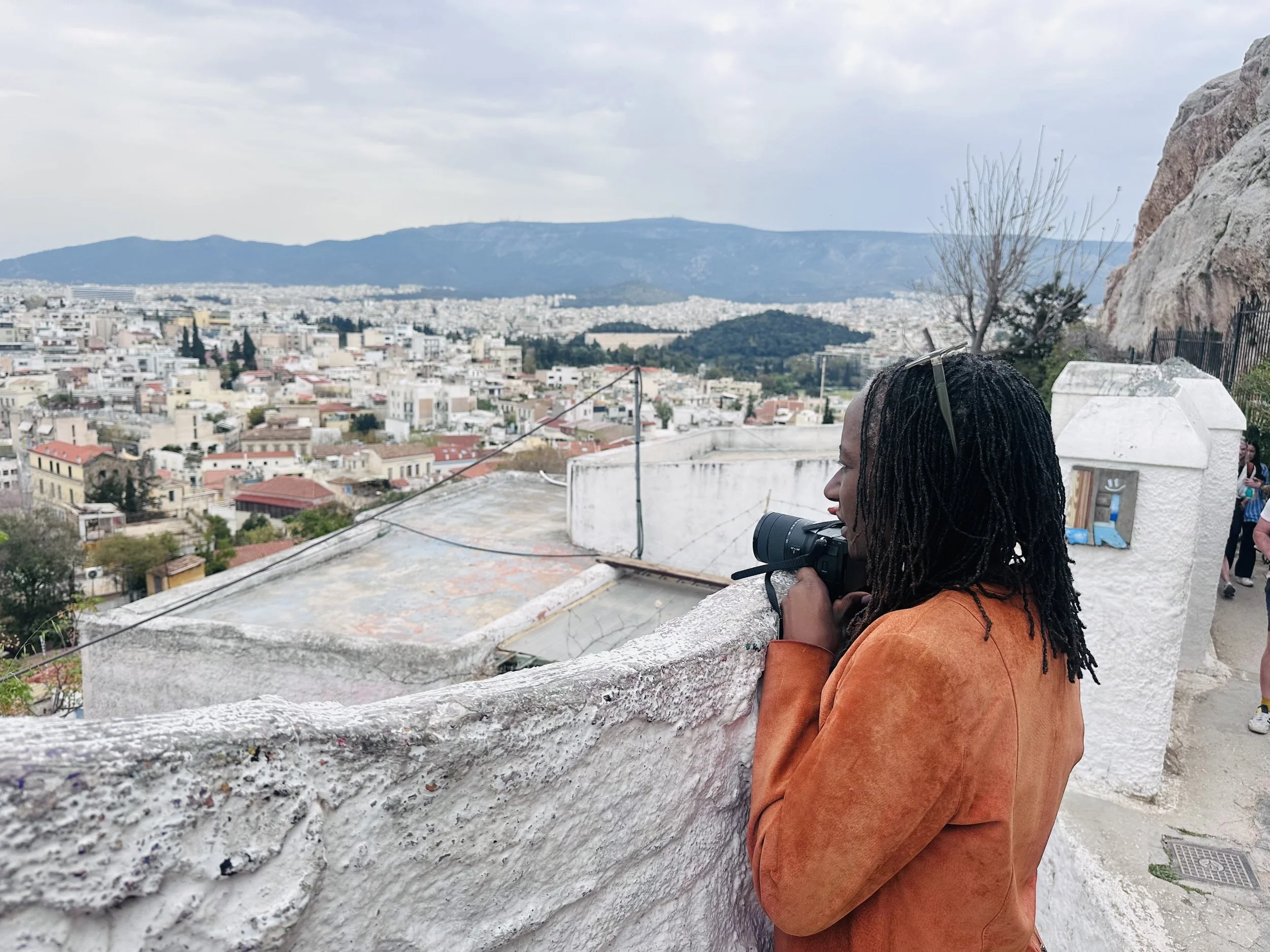
Looming literally above our apartment was Mount Lycabettus. We walked the uphill path two nights in a row because once simply wasn’t enough to take it all in. Standing at the peak, it was a breathtaking experience to see how dense the city truly is, building after building packed together like a mosaic of concrete and history. We stayed for dinner on the mountain, watching as the sun dipped and the Acropolis began to light up across the way. From that height, the pain on the walls below was invisible, replaced by a magnificent, glowing silhouette of human achievement. It offered a necessary perspective: the city is both its struggle and its beauty, existing simultaneously.

We eventually made our way to the Acropolis itself. Standing in the shadow of the Parthenon, one cannot help but feel the crushing weight of time. It is a masterpiece of man’s ingenuity, yet I found myself thinking of the hands that built it. While history often credits the statesman Pericles and the architect Phidias, these monuments were erected by thousands of laborers, including enslaved people and low-status craftsmen. It is a striking paradox. The hierarchy of rank and the massive egos of ancient rulers who created something of eternal beauty on the backs of those they deemed lesser. Looking from the ancient ruins back down toward the graffiti-covered streets of Charilaou Trikoupi, I realized that the struggle between the rulers and the rest hasn’t changed much in three millennia.

Three days later, we transitioned from the gritty rebellion of Athens to the serene waters of Loutraki. As we drove uphill and away from the dense, bustling heart of the city, the landscape began to shift, trading concrete for the vast, open blues of the Gulf of Corinth. We arrived at the Ramada by Wyndham Loutraki Poseidon Resort, a beautiful sanctuary tucked away between the sea and the mountains. The resort felt almost purposely secluded, far from the distractions of any town. It was a peaceful place designed for reflection, keeping us focused entirely on the conference and the deep connections being made.

I was there to attend the ebbf (Ethical Business Building the Future) conference. I had been invited by a dear friend who, in another twist of fate, couldn’t make it. But as this trip has taught me, I was exactly where I was meant to be. The theme of the conference was Reorienting Towards Hope. In its root, to reorient means to look toward the East, the direction of the rising sun and the birthplace of light. The contrast was jarring but necessary. In Athens, I saw the shadow, the hopelessness and the anger of the youth. In Loutraki, I found the light. I met people from all over — Portugal, Haiti, Rwanda, and the US — leaders, creatives, and youth who are intentionally building new systems.

Unlike rigid, lecture-heavy conferences I’ve attended in the past, this was a community of people turning to the light, actively driving the narrative forward by transforming their communities. Through Knowledge Cafés and Future Salons, we didn’t just ask “What can we fix?” but “Who must we become?” and “How do be become protagonist for change?” I met researchers, business professionals, and creatives. I shared my work with educators dedicated to changing the world through children. Every meal was a seamless continuation of a deep, spiritual conversation. I realized that the rebellion I saw on the walls in Athens and the reorientation I felt in Loutraki are two sides of the same coin. The young people in the city are screaming because they care; they are rebelling against a world that feels incoherent. Our job, as a global community, is to provide the shepherding and the ethical blueprints to turn that rebellion into constructive change.

I left Greece with a renewed sense of belonging. I am part of a global network of people who refuse to succumb to apathy. As I prepared for my next stop in Lucca, Italy, I carried with me the lessons of the Athenian walls and the Loutraki shore: that we must choose, again and again, to face the light, to act, and to become the change we seek. As Václav Havel once said, “Hope is not the conviction that something will turn out well, but the certainty that something makes sense, regardless of how it turns out.”

I don’t have the answers for the hopeless, but I know that I must impact my sphere of influence. We must guard against the despair of the walls by becoming the lighthouses of the future.

Thank you for reading. Please like, share, subscribe and comment. Follow me on Substack and Medium.

To learn more about EBBF, visit https://www.ebbf.org/. ebbf is a Baha’i-inspired global learning community that accompanies mindful individuals and groups through daily work and discourse to transform business and the economy thereby contributing to a prosperous, just and sustainable civilization.